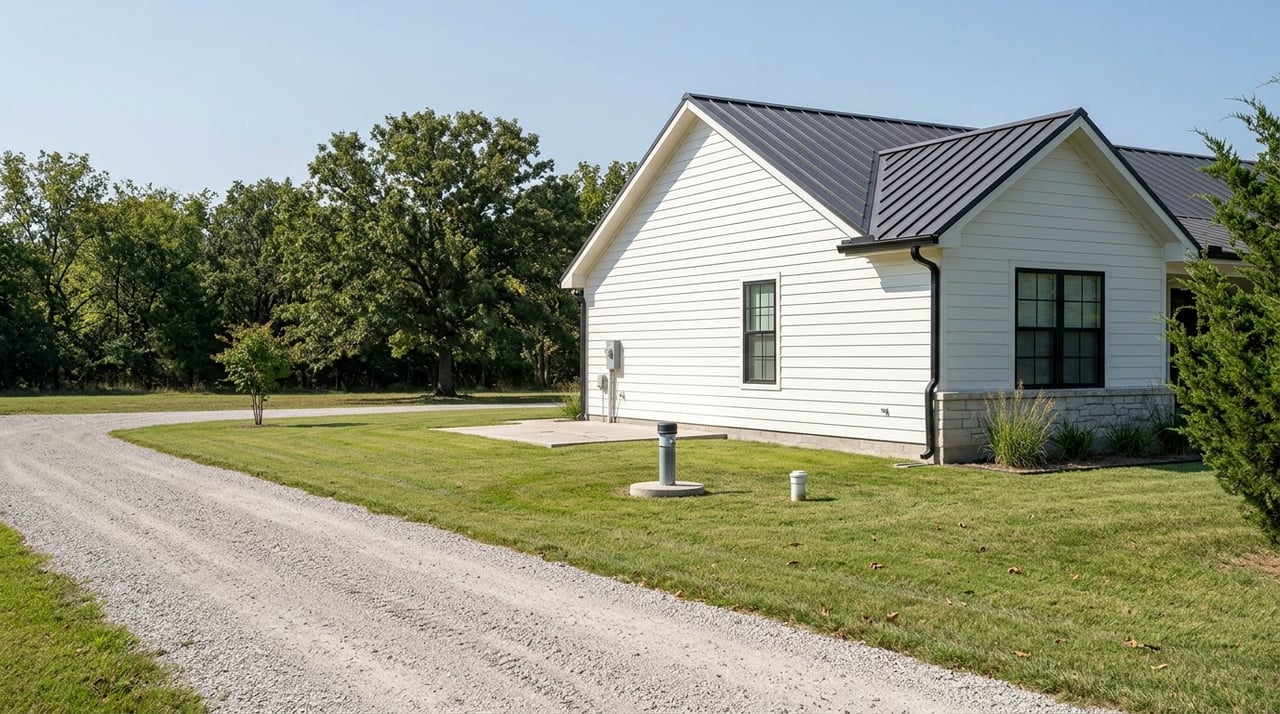
Oologah Acreage Homes Buying Guide: Wells, Septic & Zoning
Thinking about buying land in Oologah? Acreage can offer more space, privacy, and flexibility, but it also comes with questions that do not always come up in a typical neighborhood home purchase. If you are looking at land or a home on acreage in Oologah, understanding wells, septic systems, zoning, and access issues can help you avoid expensive surprises. Let’s dive in.
One of the first things to confirm is whether the property is inside Oologah town limits or in unincorporated Rogers County. That matters because the Town of Oologah has its own zoning ordinance and subdivision regulations, while Rogers County handles building permits, plan review, and inspections for structural, electrical, plumbing, and mechanical work.
For many acreage buyers, zoning is the foundation of the whole decision. You are not just buying land. You are buying a property with specific use rules, lot standards, and development limits attached to it.
In Oologah, two zoning districts often matter most for acreage: Agricultural Residential (AR) and Residential Estate (RE). According to the Town of Oologah zoning ordinance, the AR district is meant for areas that are not yet ready for urban-scale residential use and still support agriculture and related uses.
The same ordinance shows that AR lots require a minimum of 2.5 acres and 165 feet of frontage. The RE district is intended for large parcels at low urban density, and the code states that on-site sewage disposal may be used there.
If a zoning boundary is unclear, the Board of Adjustment makes the final determination. That is why it is smart to verify the exact district early, not after you are already deep into inspections and financing.
For lot splits and subdivision-related questions, Rogers County also has subdivision regulations that can affect how land may be divided and used.
Water is one of the biggest practical questions when buying acreage. In rural areas around Oologah, a property may be connected to a public water system, served by a rural water district, or rely on a private well.
The Oklahoma Department of Environmental Quality explains that if you pay a water bill, you are typically using a public water system. Private wells are different, and the state does not require routine testing for them, but DEQ strongly recommends regular testing and notes that lenders often require at least total coliform and E. coli testing before closing. You can review those recommendations in the DEQ’s home water testing fact sheet.
Rogers County also provides a rural water districts resource, which can help you identify whether a parcel may fall within a service area. Even then, it is important to confirm whether a physical hookup already exists.
If the property uses a private well, treat it like a major inspection item. Ask about:
DEQ recommends annual testing for total coliform bacteria, nitrate or nitrite, conductivity, and pH. It also recommends new testing after repairs or on newly drilled wells. If there is nearby oil and gas activity, DEQ recommends a broader panel that can include chloride, sulfate, sodium, barium, strontium, and conductivity.
For typical domestic household groundwater use, the Oklahoma Water Resources Board states that a permit is not required. However, non-domestic water uses may require a permit, so that is worth verifying if your intended use goes beyond ordinary residential use.
If a property is not connected to a public sewer system, septic feasibility becomes a major part of due diligence. The Oklahoma DEQ explains that on-site sewage systems can include conventional septic systems, aerobic units, low-pressure dosing systems, and lagoon systems. Before installation, the property needs a soil test, and the installer must obtain an Authorization to Construct through DEQ’s on-site sewage program.
All on-site systems must also be inspected by a DEQ-certified installer or DEQ. If the site requires an alternative system, DEQ approval is required before installation.
This matters in Oologah because zoning and septic feasibility are closely connected. The town’s RE district specifically allows on-site sewage disposal, but that does not mean every parcel will automatically support a standard system. Soil, slope, and available land area still matter.
OSU Extension’s septic system basics guide gives helpful planning benchmarks for rural buyers. It notes that:
Steep slopes can also create challenges, so land that looks buildable at first glance may still need a more detailed septic review.
If the lot is small, sloped, or near water, ask whether a more complex system may be required. That can affect both cost and future use of the property.
Acreage often looks simple online, but access issues can become a major problem if they are not reviewed early. According to the Rogers County subdivision regulations, certain lot split rules apply when resulting parcels are under 10 acres, and each lot must front on an existing street with at least 30 feet of frontage on a public maintained county road or on a private roadway and easement.
The same regulations state that lots must have direct access to a street or maintained county road and that utility access easements must be adequate. That means a parcel may need more than just a visible driveway. It needs usable, recorded access that works for everyday living and future improvements.
Before closing on acreage, review:
If a property is landlocked, depends on a shared drive, or sits at the end of a private lane, make sure the access is recorded and broad enough for utilities, emergency access, service vehicles, and normal use.
Floodplain risk is another issue that can catch buyers off guard. Rogers County states that about 15% of its land lies in the floodplain, and the county maintains floodplain and stormwater resources for development and remodel review in affected areas.
If the property is near a creek, drainageway, or Oologah Lake, do not assume the most attractive part of the land is the best place to build. A floodplain review should be part of your due diligence, especially if you are buying land with plans to add a home, shop, or other improvements later.
Many buyers are drawn to acreage because they want flexibility. You may be thinking about gardening, keeping animals, building out a more rural lifestyle, or even exploring a lodging or rental concept. In Oologah, those plans should be verified through zoning, not assumed.
The town’s zoning ordinance defines agriculture broadly, including farming, ranching, dairying, pasturage, horticulture, animal and poultry husbandry, and accessory uses. It also explains that some uses require specific use permits and are reviewed based on their effect on surrounding properties and areas.
The ordinance also includes visitor accommodation categories such as bed and breakfast and hotel or motel uses. Based on the ordinance text, lodging-related plans should be treated as a zoning verification issue rather than something you assume is allowed by default.
If you are considering acreage in Oologah, verify whether the property supports your intended use, including:
Even if the land is large enough physically, zoning, setbacks, septic capacity, access, and recorded restrictions may still control what you can actually do.
Before you move forward on acreage in Oologah, try to confirm these items as early as possible:
Acreage purchases can be incredibly rewarding, but they tend to work best when you look closely at the land’s practical limits before you fall in love with the view.
If you are considering land or a home on acreage in Oologah, having a steady local guide can make the process much easier. Susan Olivarez can help you sort through the details, coordinate the right questions early, and move forward with more confidence.
Stay up to date on the latest real estate trends.

Receive support in evaluating the current property's worth, formulating a compelling bid, composing and haggling over a contract, and a host of other services. Reach out to me now.